It would not be a real winter for me without a few rooting experiments going on. This is seriously one of the nerdy joys of my life. 🤓 Even though I have a rooting method that is very successful for me, I am not content to leave well enough alone. The drive to learn more and understand how things work is just… there! I know I am not alone in this, so here is to my fellow learners and observers of life.
A rabbit hole I intend to fully dive into soon is on paramagnetism and plant health. I have only dabbled in it so far. Paramagnetism is said to be “a powerful growth force which enhances root development and stimulates the multiplication of microorganisms.” — Nexus Magazine
Sounds intriguing, yes? I mean… I would like to have a powerful-growth-force-that-enhances-root-development on my cuttings, wouldn't you? In various places around the world, better plant growth has been seen at places with rocks that have high paramagnetic qualities. One article mentions that there is a 6-point difference in Brix between plants grown in low- and high-paramagnetic soils. Why does this phenomenon seem to benefit plants?
Phil Callahan at one time speculated that paramagnetic materials are a source of subterranean light to increase root growth. In an interview with Nexus Magazine, he stated: “Paramagnetic force is light from rocks for the roots. The rock is actually a transceiver, collecting magnetism from the cosmos and throwing it back out to the roots. If you take a paramagnetic rock and put it into Dr [Fritz-Albert] Popp’s lab in Germany and measure it with his instruments which count photons one at a time, you’ll find that a highly paramagnetic rock puts out 2,000 to 4,000 photons. If you put that rock with some compost, if you treat it organically, it goes from 2,000 to 4,000 photons to 400,000 photons. Now you are generating a light for roots. Roots are wave-guides, just like the antennae on insects. If you clean off the roots and shine a light on them, they’ll wave-guide just like a fibre optic. Dr Popp has a US$100,000 instrument to measure light in the form of photons...
“Some of my experimental work suggests huge increases in plant performance. For example, I took rye grown in sandy soils with a paramagnetic level of 60 cgs [centimetres-grams-seconds] and fed those soils with paramagnetic rock. The rye, before treatment, had 10 to 15 nitrogen nodules on the roots, but after treatment the number increased to 200 nodules. It suggests that the bacteria in the soil can’t convert minerals into a plant-available form without this paramagnetic force. They will never utilise all that fertiliser they’re dumping on them without the paramagnetic force. This force is to roots what light is to chlorophyll. If you don’t have light, then chlorophyll can’t work. If you don’t have paramagnetic force, then the roots can’t work…
“Paramagnetism stimulates bacteria to increase the bio-availability of micro- and macro-nutrients, but if you don’t have those nutrients present, you won’t get the desired results. You could theoretically have a soil measuring 15,000, but without calcium it would not produce… Soil life is the thing. Paramagnetism works with compost. There may be hundreds of organic growers out there doubling their yields, but when you apply the same material to a dead, chemically farmed soil it won’t work. If you don’t have a minimum level of organic matter, paramagnetism doesn’t work… compost is the key.”
It is also stated that paramagnetic materials can increasing water holding capacity in soils up to 50%. It is thought that this is one reason why certain cultures were able to farm in places with low rainfall or why some plants do so well growing out of rocks.
So here are the stated benefits of paramagnetism: 1) increased water retention, 2) microbial stimulation and increased earthworm action, 3) improved nutrient utilization, 4) improved seed germination, 5) resistance to predators and environmental stresses.
A little late to say this, but what is paramagnetism? This term is used to describe an energetic alignment with Earth’s magnetic field. Paramagnetic materials align their own magnetic field in the same direction as magnetic poles, whereas diamagnetic materials align their fields in the opposite direction from these poles. Water and plants are diamagnetic. Soil is paramagnetic.
What increases paramagnetism in soils? Correcting calcium to magnesium ratios and increasing oxygen helps with this. Calcium is paramount in order to get a good response from paramagnetic rock dusts. Oxygen is considered a highly paramagnetic gas. Its association makes sense since higher oxygen content is often associated with volcanic rock, and volcanic rock is associated with higher paramagnetism. Basalt crusher dust can be highly paramagnetic. Good quality compost is important for paramagnetism to work. Also, having all of the minerals available and good microbial levels. Biochar can be paramagnetic according to some. Granite also has paramagnetic qualities.
Disclaimer: This is a personal experiment and not a recommendation. Feel free to join in for your own fun, but please do not be disappointed if it does not work out as expected. This is not a tried and true method as of yet. Read and follow at your own risk!
The second experiment…
High Paramagnetic Rooting Medium
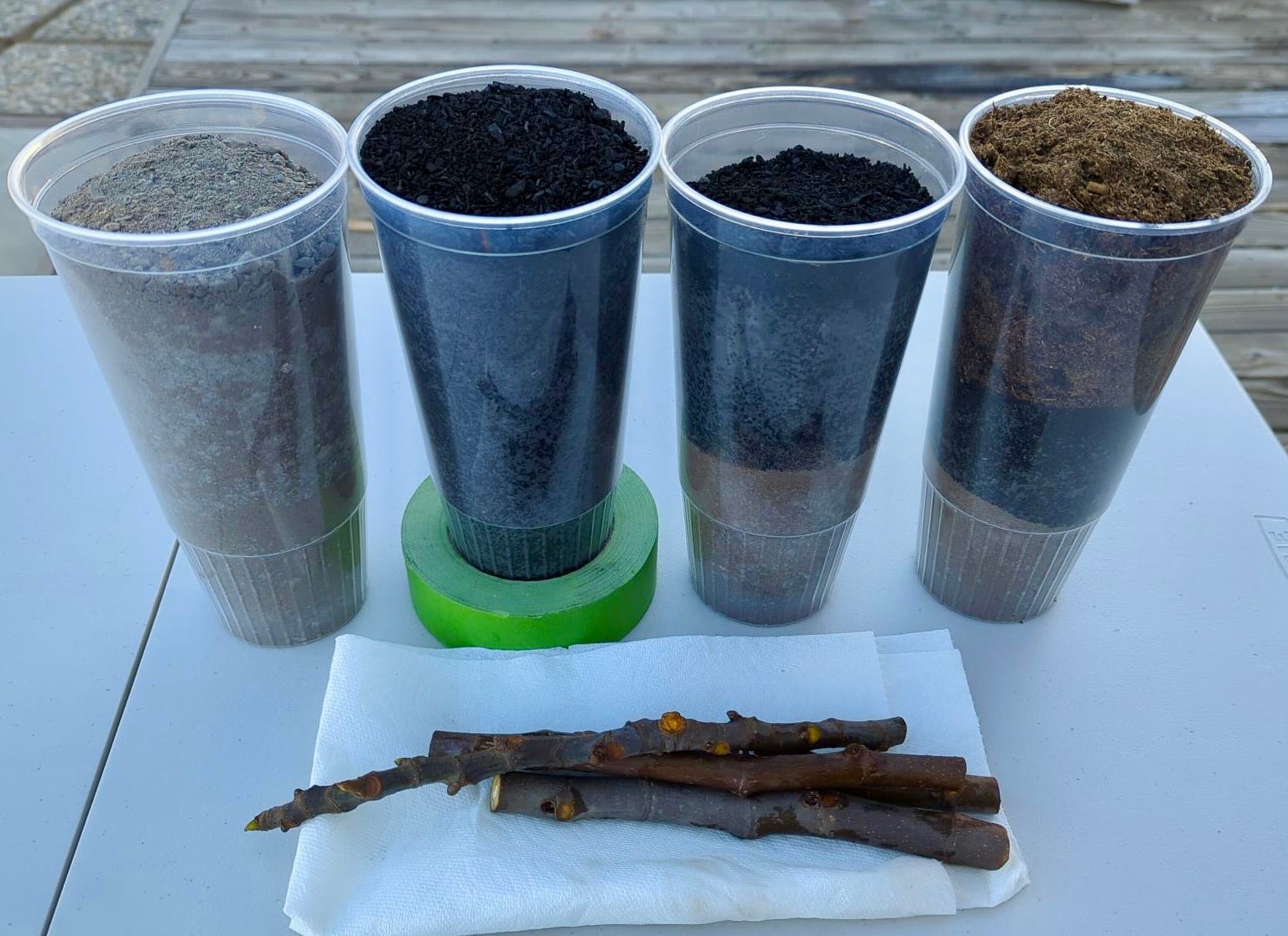
I have four cuttings. Two are the same variety and two are different. The cuttings were soaked for 48 hours in dilute seaweed water.
(In a true experiment, they would all be the same variety, from the same location on the branch, but this is informal and for fun. 😉)
The 1st cup contains all basalt. The 2nd cup contains all biochar. The 3rd cup contains equal parts basalt and biochar. The 4th cup contains equal parts basalt, biochar, and peat.
Nutrients: All four cups have 1/2 cup each of soft rock phosphate and worm castings added. I am watering with seaweed water that has a little dab of fig FPJ. The biochar I got was already charged by the seller with soy amino acids.
Initial Thoughts…
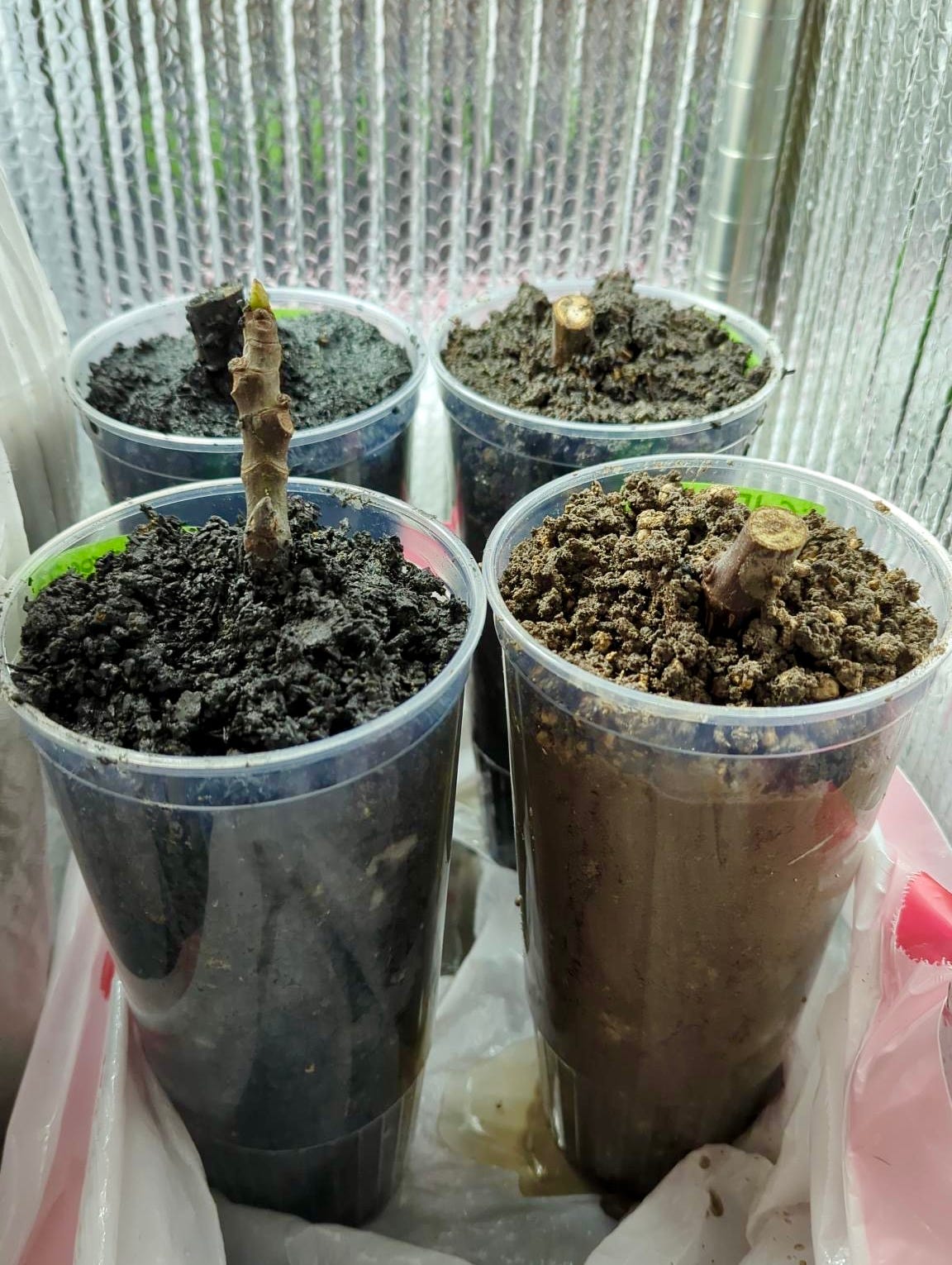
Granted, I do not have a meter or any tool to check for paramagnetism. I have no idea if the products I used register high or low cgs. So this is an experiment based on guesses and hopes that they are high. The ingredients themselves can be and should be high, but anything that is exposed to weather or water can be low despite what material they are. So everything being done is just for personal observation.
The basalt I received this time was more dust-like and less sandy than previous ones I have gotten. This is great for an amendment, but maybe not so great for rooting in. It came out very sludgy. I have concerns that there may not be enough air and that it may pack around the cutting making it hard for roots to work through.
I think ideally basalt and biochar would be used just as amendments to whatever standard rooting medium is used and they are less ideal as sole rooting mediums. But still, this is an interesting experiment to me, so we’ll see what happens. I think the chance for success is lower with this one, so no one hold their breath!
Let’s await the results…

Nothing seems more fitting than music tuned to 432 Hz which connects to Earth’s natural frequency of 7.83 Hz, and Chopin’s Nocturnes at that, to go with the darkest rooting medium I have ever used. Enjoy and relax for a moment as we align with the Earth —
I can just picture it… everyone’s fingernails if biochar turns out to be a good rooting medium, hehe. 🌘
What do you think? Will they root?? Will they croak??? How will you know??!